




How Buying a Home Before Selling Puts More Money in Your Pocket
Read more


Low down payment and low rate home loan options for Seattle
Monday - Sunday | 8:00 am - 8:00 pm
We will never rent, sell, or misuse your data, ever.
A Division of City Mortgage Brokers, LLC
MB#2158059

By the time most people finish house hunting, they know the home they want to buy better than the one they already own.
They've walked through it three times, pulled the comps to check its market value, and even had a chat with the bank.
Selling feels like the easy half, the part that sorts itself out afterward.
But selling isn't as simple as it feels. One decision matters more than anything else: do you buy first, or sell first?
That single question can move your current house's sale price by tens of thousands.
When you sell first, you're asking a buyer to commit to a closing date when you can't commit to one yourself, so the flexibility you need ends up giving buyers leverage over your asking price.
Not to mention, you're also showing a home you still live in, whereas a vacant and staged home would have commanded a higher price.
Buying first eases both of those problems.
What it doesn't solve is how you can carry two properties at the same time, on top of your existing mortgage.
That’s what we’ll be breaking down in this article.
Buyers rarely realize it, but when you sell first, you're selling against a date.
Say you list in April.
An offer comes in $20,000 below what you wanted. Normally, you would counter and wait a few weeks for a better one.
But on your end, you've already found the new house you want, and if the sale on your current home doesn't close on time, you lose it.
So you accept.
On the surface, this scenario may seem like a typical negotiation. But in reality, it's a deadline discount.
The only real defense against a low offer is being able to walk away from it, but a closing date takes that away, and the buyer's side can usually tell.
Your real estate agent mentions you're hoping to close by June. Or, maybe your listing shows a price cut in week three. From there, offers get written to test how badly you need the date.
Some sellers try to solve this with a rent back agreement, staying in the home after closing. But that's one more thing the buyer gets to price into their offer.
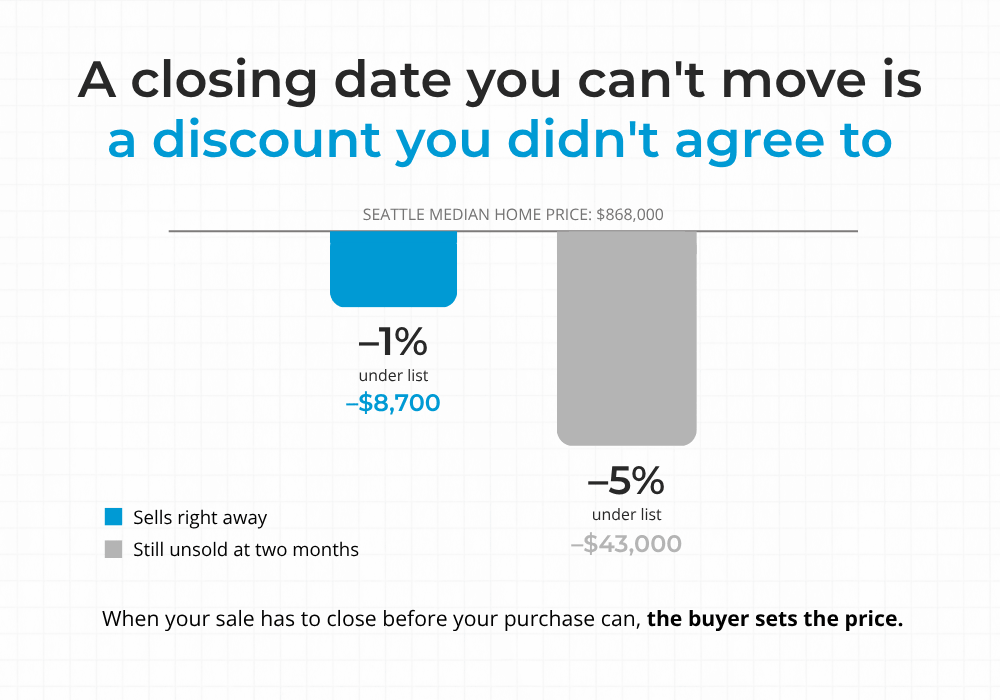
Research conducted by Zillow shows exactly what waiting can be worth.
Homes that sell right away close about 1 percent under list, while homes that remain unsold at the two-month mark close about 5 percent under.
In a housing market like Seattle's, where the median home price was roughly $868,000 in 2026, that's the difference between giving up $8,700 and giving up $43,000.
As we mentioned previously, creating a deadline on the sale of your home takes money off your sale price. However, living in your existing home while you sell can take even more.
Put yourself in the buyer's shoes.
They walk into a new space eager to see the vaulted ceiling in person, or the marble countertops that looked so good online. What they end up feeling is that they're walking through someone else's space.
The furniture you brought from your last place doesn't quite fit the room, coats are stuffed in the entry closet, and the photos on the wall are of a family that isn't theirs.
None of these things represents a flaw or defect in the house. But it keeps the buyer from seeing the house at its best, and it never gives them the chance to picture their own life in it.
Meanwhile, a staged home is built to maximize your return.
The furniture is scaled to make rooms feel bigger, and everything is arranged to pull the eye toward the features that made the buyer click in the first place.
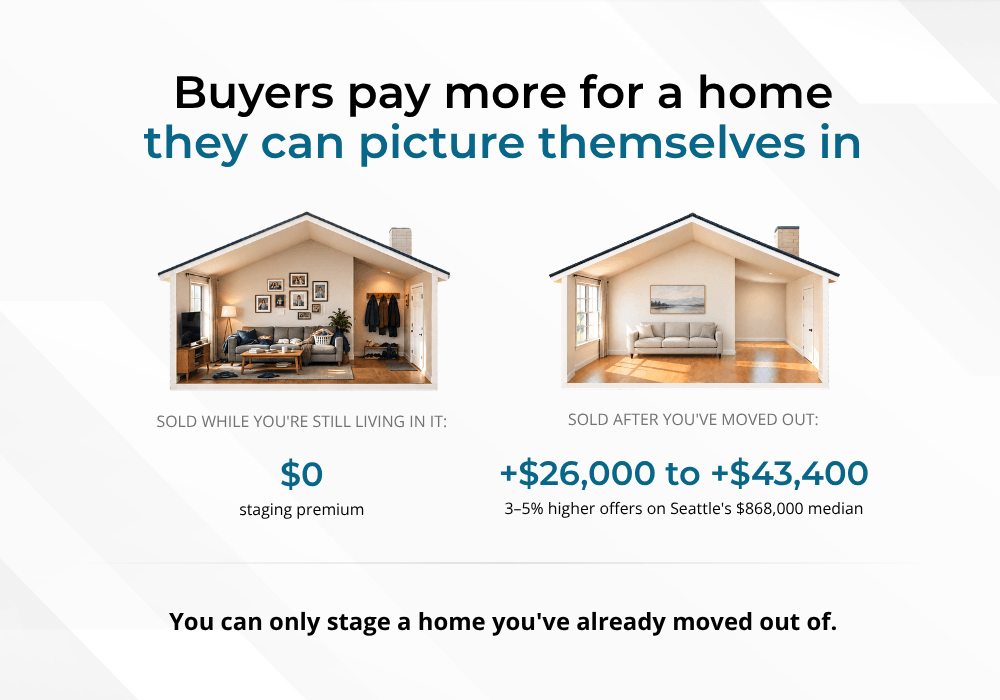
In its 2025 Profile of Home Staging, the National Association of Realtors concluded that 29 percent of agents said staging led to offers 1 to 10 percent higher than comparable unstaged listings.
For context, just three percent on Seattle's $868,000 median house price is about $26,000, and five percent is $43,400.
That’s all money you can't collect if you're still living there. And when you roll that into what the deadline already costs you, a median Seattle seller is looking at somewhere between $35,000 and $86,000 left on the table.
But those losses aren't set in stone. They come from the order you buy or sell, and order is something you can change.

The most frustrating part about the number we just added up is that none of it has anything to do with your house.
It's simply the by-product of the order in which you buy and sell.
The deadline discount only happened because you have a closing date bearing down on you the second you list. And the staging premium stays out of reach because you're still living in the home you're trying to sell.
That sequence isn't a rule you have to follow. It only feels that way because your sale proceeds and any existing equity are sitting in the house you're standing in.
That sequence is what the Contingency Buster Program was designed to reverse, letting you buy a house before selling the one you're in.
Here's how it works.
Before your current property ever goes on the market, Seattle's Mortgage Broker secures a guaranteed backup purchase contract on it. That gives you a committed buyer and a backup plan already in place before you make your next offer, and if your estimated equity is at least 25 percent, you already qualify.
With that contract behind you, your purchase offer on the dream home you want goes in clean, with no home sale contingency. Meaning in competitive markets, there's no contingent offer for a seller to weigh against the cash buyer standing beside you.
That means you keep the money you would have lost by selling under pressure.
With a committed buyer already behind you, the selling process gets a lot easier. On the purchasing side, your offer on your next purchase goes in clean, you close on it, and you transition directly into your new home with no temporary housing and no double move.
On the selling side, the payoff is even bigger. The home you just left is empty when it hits the market, professionally staged and photographed the way it deserves to be, and it gets to do its job: impress buyers, with no closing date forcing your hand.
That freedom changes what happens when a low offer arrives, and one usually does. With our Contingency Buster Program in place, you can counter it, or wait a few weeks to see what else comes in at your own pace, because nothing depends on that buyer's signature. A buyer can’t price an offer against your clock when you no longer have one. The deadline discount never happens, and the staging premium is yours to collect.
All of it comes back to one idea.
Selling first discounts your home, and buying first is how you sell for more.
And one short conversation with Seattle's Mortgage Broker is enough to show you the home equity you're protecting by selling in the right order on your next move.
Joe Tafolla is the founder and lead mortgage broker at Seattle’s Mortgage Broker, a full-service mortgage consulting firm dedicated to helping homebuyers secure financing with competitive rates, faster closings, and personalized service.
With more than two decades in the mortgage industry, Joe has helped hundreds of families achieve homeownership.