

How To Buy Before Selling Without A Bridge Mortgage Loan

Table of Contents

bridge mortgage loan

You found the home. The price works. The neighborhood is right. 

You make an offer, but then disaster strikes.

Despite your competitive bid, you lose out because your offer carried a condition the seller had no reason to accept.

That's the home sale contingency problem in Seattle's real estate market, and it plays out every week for buyers who are fully qualified but structurally disadvantaged the moment their offer hits the table.

Most buyers assume the sell-first condition is unavoidable if they haven't closed on their current home yet. 

But it isn't. That condition is a variable you control, and removing it changes how sellers see your bid entirely. 

Before you can remove it, however, it helps to understand what it costs you on the offer you're about to make and on the mortgage you'll carry for the next 30 years.

What a Bridge Mortgage Loan Actually Costs

The conventional move for Seattle buyers trying to purchase a new home before they sell is a bridge loan, sometimes called a swing loan or gap loan. 

The appeal is straightforward: short-term financing that covers the gap between your home purchase and your sale, funded against the equity in your existing home.

What the pitch glosses over is the qualification bar. 

What’s Required For A Bridge Mortgage Loan?

Borrowers typically need to meet a minimum credit score of 600 to 680, demonstrate stable income through pay stubs or tax returns, and keep a debt-to-income ratio below 50%. The part that eliminates more buyers than expected: you must qualify for both the bridge loan and the new home loan simultaneously. 

That’s two full loan applications, two debt service obligations, all evaluated at the same time.

For a Seattle mortgage above $500,000, the math gets uncomfortable quickly. Bridge loan interest rates tend to run higher than traditional mortgage rates. 

The term on most bridge loans runs six months to a year, with repayment terms that often include a large balloon payment at the end. If your existing home doesn't sell within that window, you're managing two mortgages with no resolution in sight.

Short-Term Gain vs. Long-Term Cost

Bridge loans provide fast access to capital, which matters in competitive markets where sellers expect certainty. But that speed comes at a price. 

The new purchase mortgage comes in at a rate shaped by timing pressure, not optimal market conditions. If you enter that mortgage without a follow-on strategy, the rate you locked under the deadline becomes your default for years, not months.

Every month you carry an above-market rate past the first eligible refinance window is interest permanently paid, not a gap a future refinance can recover retroactively.

This is the hidden cost most bridge loan borrowers don't see coming. The short-term solution solves the immediate timing problem while creating a long-term issue that ends up costing homeowners.

The Hidden Costs Most Bridge Loan Borrowers Don't See Coming

Beyond the interest rate exposure, a standard bridge loan carries its own set of upfront costs. 

Origination fees, appraisal requirements, and closing costs all add up on a product you're using for less than a year. 

Bridge loan lenders require appraisals on the existing property used as collateral, and those fees are due regardless of how quickly your current home sells.

Then there's the monthly payment structure. Bridge loans typically allow for interest-only payments during the loan term, with the principal due in a lump sum when the existing home sells. That means you're funding two mortgages simultaneously, even if one is interest-only. 

For buyers whose budget was sized around a single payment, the gap between what they planned and what they're actually paying can be significant. 

Borrowers who can't sell their current property in time face the further risk of paying two mortgages indefinitely, a cash flow problem that compounds the longer the existing home sits.

Bridge Loan Alternatives Worth Understanding

Before committing to a bridge mortgage loan, buyers in Seattle should understand what else is available, and the pros and cons of each.

Home Equity Loan

A home equity loan allows homeowners to borrow against existing home equity in a lump sum, typically at lower interest rates and with longer repayment terms than bridge financing. However, it requires the existing home to already have substantial equity and demands stable income to qualify,  but it avoids the dual-mortgage pressure that makes swing loans difficult to manage.

Home Equity Line of Credit

A home equity line of credit, or HELOC, offers a more flexible version of the same concept. 

Rather than a lump sum, a home equity line gives borrowers access to a revolving credit facility against their existing property, with lower closing costs than most bridge loans and the ability to draw only what's needed. Bridge loan interest rates tend to exceed what a HELOC charges, which makes the home equity line a more cost-efficient option when time allows.

80-10-10 Loan

An 80-10-10 loan, also known as a piggyback loan, splits the purchase into two mortgages and a 10% down payment, letting buyers avoid private mortgage insurance while keeping the primary loan below conforming limits. It solves a different problem than a bridge loan but brings further complexity in examining and understanding the full picture of short-term financing options.

Personal Loans

Personal loans represent another financing option in theory, though in real estate transactions above $500,000 they rarely cover enough ground to be practical. They may have no collateral requirement but often come with higher rates and shorter loan terms than secured alternatives.

Is There A Better Way?

Each of these bridge loan alternatives may offer something that a bridge loan doesn’t, but the problem is that none of them, including the bridge loan itself, removes the home sale contingency from your offer. 

They fund the gap. They don't fix the structural problem that's costing buyers deals in competitive markets.
How Seattle's Mortgage Broker Turns Two Decisions Into One Strategy

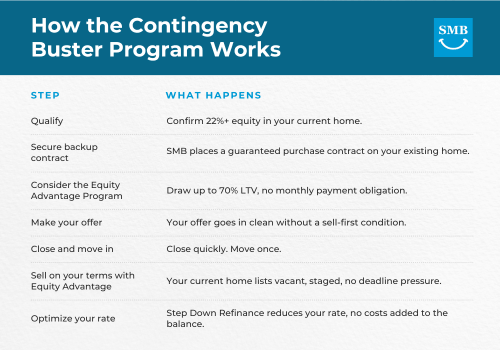
How the Contingency Buster Program Works

Seattle's Mortgage Broker built the Contingency Buster Program to solve the timing problem without the financial exposure a bridge loan carries.

How does it work?

Before you make an offer on the next home, Seattle's Mortgage Broker secures a guaranteed backup purchase contract on your current home. That contract means a committed buyer is already in place before your offer hits the table. 

With that contract secured, your offer goes in without a home sale contingency. The seller receives a purchase offer backed by certainty, not a conditional deal that depends on a second transaction they can't control.

Seattle's Mortgage Broker closes quickly and allows you to compete directly with cash offers. That speed is what allows the backup purchase contract to function as the credible guarantee a seller needs to accept the offer.

Realtors across Seattle can also use this program with their clients, specifically because it delivers a contingency-free offer without the financial complexity a bridge loan introduces. 

The program solves the timing problem by removing the condition, not by layering on additional debt.

How Equity Advantage Funds Your Next Move Without a Bridge Loan

The most common reason buyers reach for bridge financing is because they need to fund the down payment and cover transition costs before their current home sells. 

Equity Advantage is the feature within the Contingency Buster Program built specifically for that purpose, and it works differently than any bridge loan alternative on the market.

The program removes three specific obstacles a bridge loan leaves in place:

  1. First, there's no dual-qualification requirement, you're not applying for a bridge loan alongside your new mortgage. 
  2. Second, there's no monthly payment obligation on a short-term loan running concurrently with your new purchase. 
  3. Third, your offer arrives without the sell-first clause that gives sellers a reason to choose the cleaner bid.

How Does Equity Advantage Work?

Buyers can access up to 70% LTV of their current home's existing home equity before it sells. The advance carries zero monthly payment obligation during the transition, there's no interest-only payment, no second loan running against your budget, no impact on your debt-to-income ratio. 

The full amount is repaid through escrow when your current property closes, repaid in a single lump sum from the sale proceeds with no payment schedule to manage in between.

That advance can go toward the down payment, closing costs, staging, renovations, moving expenses, or debt payoff to strengthen qualifications before the new home purchase. 

There are no restrictions on use. And because there's no payment obligation, the buyer's cash flow stays exactly where it was throughout the transition, no budget pressure, no mortgage payment juggling, no financial stability concerns during the move.

Compare that to what a bridge loan requires: dual qualification, bridge loan interest rates higher than traditional mortgages, monthly payments on a short-term loan, and a balloon repayment at the end. 

Equity Advantage is designed to do what gap financing does, bridge the gap between home purchase and sale, without any of the cost structure or qualification complexity that makes most bridge loans a difficult tool to use well.

The financial exposure that defines the bridge loan experience isn't present in this structure.

What Happens When Refinancing Costs You Nothing?

Once your current home sells and the equity is settled, the rate on the new mortgage is the decision that determines long-term financial outcome. 

That's where the Step Down Refinance program becomes the third leg of the strategy.

Seattle's Mortgage Broker has a client who completed a purchase followed by two refinances in roughly eighteen months. That client chose to hold the monthly payment steady throughout and compress the amortization schedule instead of reducing the payment. The result: 11.5 years removed from the loan term and more than $500,000 in lifetime interest eliminated.

That outcome was possible because each refinance carried zero added cost to the loan balance. 

The total loan costs, processing, appraisal, credit, title, settlement, were zeroed out or refunded at closing. With no recoup period required between refinances, the client was able to act every six months as rates moved, compounding savings that no single perfectly-timed refinance could have delivered.

The conventional "save 1% before refinancing" benchmark exists because a standard refinance carries $6,000 or more in total loan costs that have to be offset before the math makes sense. 

When those costs are eliminated, the threshold for acting drops dramatically. A smaller rate improvement justifies acting sooner. Acting sooner means the rate drops faster. The interest that would have compounded at the higher rate for another year simply doesn't.

The Step Down Refinance is a post-sale optimization that can combine with the Contingency Buster Program, so that the purchase decision and the rate strategy are designed together, not assembled after the fact.

Start With the Right Strategy Before You Make Your Next Offer

The best time to solve a contingency problem is before you make an offer. The best time to solve a rate problem is before you close on the loan. 

Most buyers deal with both after the fact, scrambling for a bridge loan when the timing gets tight, then sitting on an above-market rate waiting for a refinance that makes financial sense by someone else's math.

You don't have to enter the purchase that way.

One conversation with Seattle's Mortgage Broker confirms whether you qualify for the Contingency Buster Program and shows you exactly what a clean, competitive offer looks like for your situation, before you need it.

Connect with Seattle's Mortgage Broker today.

About the Author

Joe Tafolla is the founder and lead mortgage broker at Seattle’s Mortgage Broker, a full-service mortgage consulting firm dedicated to helping homebuyers secure financing with competitive rates, faster closings, and personalized service. 

With more than two decades in the mortgage industry, Joe has helped hundreds of families achieve homeownership.

What A Bridge Mortgage Loan Costs Seattle Homeowners
How To Buy Before Selling Without A Bridge Mortgage Loan
Read more
How to Sell and Buy a Home at the Same Time in Seattle
7 Steps to Sell and Buy a Home at the Same Time in Seattle
Read more
Don’t Let A Home Sale Contingency Hold You Back
How Seattle Homeowners Can Beat the Home Sale Contingency Problem
Read more
Why a Top 1% UWM Broker Wins More Offers in Seattle
How a Top 1% UWM Broker Will Help You Win The Home You Want
Read more
Refinance Fees to Avoid When Refinancing Your Home
How Homeowners Can Save More By Cutting Refinance Fees To Avoid
Read more
Best Suburbs of Seattle 2025 | Top Areas to Buy a Home
The Ultimate Guide to the Best Suburbs of Seattle
Read more
Should You Use a Mortgage Broker? Compare Brokers vs. Banks
Should You Use a Mortgage Broker? Everything You Need to Know First
Read more
Explore Neighborhoods in Seattle by Budget & Lifestyle
How to Find the Right Neighborhoods in Seattle for Your Budget and Lifestyle
Read more
Warrantable vs Non Warrantable Condo: Avoid Financing Surprises
Warrantable vs. Non-Warrantable Condos: What Every Buyer Needs to Know Before Financing
Read more
How Much Does It Cost to Refinance a Mortgage? A Comprehensive Guide
How Much Does It Cost to Refinance a Mortgage in Seattle? A Homeowner’s Guide
Read more
How Often Can You Refinance Your Home?
Read more
The Complete Guide to FSBO in Seattle
The Complete Guide to For Sale By Owner (FSBO) in Seattle
Read more
10 Questions Every Seattle First-Time Home Buyer Should Ask
10 Questions Every Seattle First-Time Home Buyer Asks
Read more
What Is A Non-Warrantable Condo? - Seattle's Mortgage Broker
What is a Non-Warrantable Condo?
Read more
Ultimate Seattle Mortgage Loan Documents Checklist
Read more
Seattle Property Tax Guide (2026): Rates, Bills & Exemptions
Your Complete Guide to Seattle Property Tax
Read more
Why You Should Work with a Mortgage Broker
Read more
Where to Find the Best Local Mortgage Broker in Seattle
Where to Find the Best Local Mortgage Broker
Read more
Guide to Finding the Best Places to Live in Seattle
Where Are The Best Places To Live In Seattle?
Read more
What’s the Best Way to Save Money for a House in Seattle?
Read more
Is It Time to Refinance? What Every Homeowner Should Consider
When is the Best Time to Refinance a Home?
Read more
 Jumbo Loan Limit in Seattle - Expert Guide
What is the Jumbo Loan Limit in Seattle 2020?
Read more
What You Need to Buy a House in Seattle - Seattle's Mortgage Broker
What You Need to Buy a House in Seattle
Read more
Jumbo Loan Guide – Understanding Seattle Home Financing
What Is a Jumbo Loan and will you need one when moving to Seattle?
Read more
Understanding Jumbo Loan Limits in Seattle
What is the Jumbo Loan Limit in Seattle?
Read more
What Is A Non-Warrantable Condo? - Seattle's Mortgage Broker
What Is A Non-Warrantable Condo?
Read more
Down Payment Amount – Find Your Ideal Seattle Budget
What is the Best Down Payment Amount on a House in Seattle?
Read more
What is PMI Mortgage Insurance? And Why It Is Not As Bad As You Think
Read more
What Is a Cash-Out Refinance? | Unlock Your Home’s Equity
What Is A Cash-Out Refinance?
Read more
What do Home Loan Underwriters Look For? - Seattle's Mortgage Broker
What do Home Loan Underwriters Look For?
Read more
What Down Payment Do I Need for a House? - Seattle's Mortgage Broker
What Down Payment Do I Need for a House?
Read more
What Are The Costs of Buying a Home? - Seattle's Mortgage Broker
What Are The Costs of Buying a Home?
Read more
Neighborhoods of Seattle to Buy a House for Families
What Are The Best Neighborhoods In Seattle For Families?
Read more
VA Home Loan Requirements: A Guide for Veterans
FAQ: What Are the VA Home Loan Requirements?
Read more
WEST SEATTLE JUNCTION | Seattle Neighborhood Tour
WEST SEATTLE JUNCTION ; Seattle Neighborhood Tour
Read more
What are RSUs and How to Spend Them - Seattle's Mortgage Broker
What are RSUs and How to Spend Them
Read more
Understanding Mortgage Down Payments - Seattle's Mortgage Broker
Understanding Mortgage Down Payments
Read more
Top 5 Seattle Suburbs to Buy a Home: Best Places to Live
Top 5 Seattle Suburbs to Buy In 2021
Read more
Understanding Down Payments in Seattle - Seattle's Mortgage Broker
Understanding Down Payments in Seattle
Read more
The Ultimate Mortgage Document Checklist - Seattle's Mortgage Broker
The Ultimate Mortgage Document Checklist
Read more
10 Questions to Ask a Mortgage Broker Before You Commit
Top 10 Questions To Ask A Mortgage Broker (Before You Commit)
Read more
The Worst First-Time Homebuyer Mistakes - Seattle's Mortgage Broker
The Worst First-Time Homebuyer Mistakes
Read more
The Top 5 Seattle Suburbs - Seattle's Mortgage Broker
The Top 5 Seattle Suburbs for 2020
Read more
The Best Seattle Neighborhoods - Seattle's Mortgage Broker
The Best Seattle Neighborhoods in 2020
Read more
Find the Top Mortgage Refinance Companies in Seattle
How to Find the Best Mortgage Refinance Companies in Seattle
Read more
Seattle Neighborhoods for Families | Find the Right Area
The Best Seattle Neighborhoods for Families
Read more
How to Choose the Right Neighborhood When Buying a House
The Best Neighborhoods in Seattle to Buy a Home
Read more
The 7 Best Seattle Suburbs for Families to Live In
The 7 Best Seattle Suburbs for Families
Read more
Seattle Neighborhood Guide: The 10 Most Affordable Areas
Seattle Neighborhood Guide: The Top 10 Most Affordable Places To Live In Seattle
Read more
SOUTH LAKE UNION | Seattle Neighborhood Tour
SOUTH LAKE UNION ; Seattle Neighborhood Tour
Read more
Seattle Summer Housing Market | Guide for Buyers & Sellers
Seattle Summer Housing Market Guide 2020
Read more
Seattle Housing Market Update - Seattle's Mortgage Broker
Seattle Housing Market Update 2020
Read more
Seattle Housing Market Hacks - Seattle's Mortgage Broker
Seattle Housing Market Hacks
Read more
Save Money When Buying a House in Seattle
Read more
Save Money on Your Mortgage Refinance - Seattle's Mortgage Broker
Save Money on Your Mortgage Refinance
Read more
Moving to Seattle? Choose the Best Suburbs in Seattle
Moving to Seattle with a Family? Here's the BEST Suburbs For You!
Read more
Refinancing To Reduce Your Bills and Increase Available Cash
Read more
Neighborhoods in Seattle to Buy a Home
Neighborhoods in Seattle to Buy a Home 2020
Read more
Real Estate Trends in Seattle - Seattle's Mortgage Broker
Real Estate Trends in Seattle
Read more
Mortgage Down Payments in Seattle – What to Expect
Mortgage Down Payments in Seattle
Read more
MAGNOLIA | Seattle Neighborhood Tour - Seattle's Mortgage Broker
MAGNOLIA ; Seattle Neighborhood Tour
Read more
Cash-Out Refinance – What to Know Before You Apply
Mistakes to Avoid with Cash-Out Refinance
Read more
Quick Home Refinance Guide - Seattle's Mortgage Broker
How to Refinance Your Home in 9 Steps
Read more
Jumbo Loan Limit vs Conforming Loan Limit | Seattle Guide
Jumbo Loan Limit vs Conforming Loan Limit in Seattle for 2021
Read more
KIRKLAND | Seattle Neighborhood Tour - Seattle's Mortgage Broker
KIRKLAND ; Seattle Neighborhood Tour
Read more
Jumbo Loan Limit | Seattle Market Insights & Buyer Guide
Jumbo Loan Limit in Seattle for 2021
Read more
ISSAQUAH | Seattle Neighborhood Tour
ISSAQUAH ; Seattle Neighborhood Tour
Read more
Is My Credit Score Good Enough to Buy a Seattle House?
Is My Credit Score Good Enough to Buy a House?
Read more
How to Buy a House in Seattle – Smart Buyer’s Tips
How to Buy a House; Home Buying 101
Read more
How to Lower Your Monthly Mortgage Payment - Seattle's Mortgage Broker
How to Lower Your Monthly Mortgage Payment
Read more
How to Get the Best Rate for Your Home Loan
Read more
How to Buy a House for Less - Seattle's Mortgage Broker
How to Buy a House for Less
Read more
How Much Home Can I Buy in Seattle? - Seattle's Mortgage Broker
How Much Home Can I Buy in Seattle?
Read more
Guide to Down Payments in Seattle
How Much Do You Really Need for a Down Payment in Seattle?
Read more
How Much Home Can I Afford – Seattle Buyer’s Guide
How Much Home Can I Afford?
Read more
Home Price Forecast for Seattle | Market Trends to Watch
Home Price Forecast for Seattle 2020
Read more
How Hot is the Seattle Real Estate Market? - Seattle's Mortgage Broker
How Hot is the Seattle Real Estate Market?
Read more
Seattle Real Estate Market | How Hot Is It Right Now?
How Hot is the Seattle Real Estate Market in 2022?
Read more
Home Inspection Questions You Need to Ask - Seattle's Mortgage Broker
Home Inspection Questions You Need to Ask
Read more
Why Do You Need a Realtor to Buy a House in Seattle?
Do You Need a Realtor to Buy a House in Seattle?
Read more
FHA vs Conventional Loan: Key Differences and Best Options Explained
FHA vs. Conventional Loan: Which Mortgage Is Right for You?
Read more
Find the Best Mortgage Lender for Your Home Loan
Read more
Federal Housing Administration Loans | Benefits & Eligibility
Federal Housing Administration Loans 2021
Read more
Down Payment Requirements in Seattle - Seattle's Mortgage Broker
Down Payment Requirements in Seattle
Read more
FACTORIA and SOMERSET | Bellevue Neighborhood Tour
FACTORIA and SOMERSET ; Bellevue Neighborhood Tour
Read more
Seattle Jumbo Loan Guide: Limits, Rates & Requirements
Need a Seattle Jumbo Loan? Here’s Everything You Should Know in 2026
Read more
Everything You Need to Know About VA Loans
Read more
First Time Homebuyer Down Payment Assistance for Millennials
Advice To A First Time Home Buyer: Down Payment Assistance Programs Exist for Millennials
Read more
Crossroads – Affordable Living in Central Bellevue
CROSSROADS ; Bellevue Neighborhood Tour
Read more
How Much Money Do I Need to Buy a House in Seattle
Down Payment 101: How Much Money Do I Need to Buy a House?
Read more
COVID-19 Mortgage Help for Homeowners - Seattle's Mortgage Broker
COVID-19 Mortgage Help for Homeowners
Read more
Comparing ARM vs. Fixed Rate Mortgage - Seattle's Mortgage Broker
Comparing ARM vs. Fixed Rate Mortgage
Read more
Buy A Home In Seattle With Smart Planning & Savings
Can I Afford To Buy A Home In Seattle?
Read more
Trusted Lenders For Home Loans In Seattle | Expert Guide
Choosing the Best Lenders for Home Loans
Read more
How to Use Restricted Stock Units to Buy a Home in Seattle
Read more
ARM v. Fixed Mortgage: Which is Right For You?
Read more
Ballard or Queen Anne? Top Neighborhood Areas of Seattle
Ballard or Queen Anne? The Best Neighborhoods of Seattle to Buy a House
Read more
Avoiding the Worst Seattle Mortgage Lenders
Read more
Are You Buying a House in Seattle? Here’s the Ultimate Survival Guide
Read more
Fixed vs Adjustable Rate Mortgage: How to Choose
Fixed vs. Adjustable Rate Mortgage: How Today’s Buyers Can Make A Smarter Choice
Read more