








4 Secrets to Buying a Non-Warrantable Condo
Read more


Low down payment and low rate home loan options for Seattle
Monday - Sunday | 8:00 am - 8:00 pm
We will never rent, sell, or misuse your data, ever.
A Division of City Mortgage Brokers, LLC
MB#2158059

This article was originally published on June 22, 2020. It was updated on August 21, 2026.
Every homeowner in Seattle wants the lowest possible interest rate on their mortgage, which is exactly why a low-rate ad is so tempting. It promises a number smaller than the one you're paying now, so refinancing feels like an easy win.
But that number is only part of the story, and it's the part designed to get your attention.
What the ad leaves out is that refinancing is never free. Every time you do it, you pay closing costs, and they add up fast.
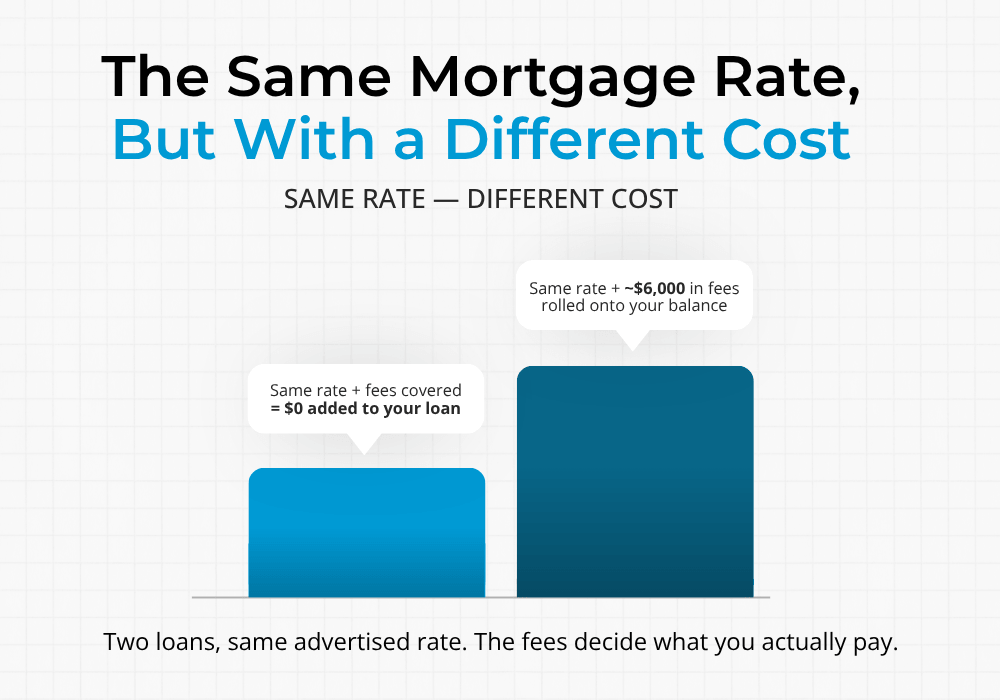
An appraisal, title and settlement, processing, a credit report, plus smaller costs behind them can reach several thousand dollars. And unless someone covers them, they get folded onto your balance, where you keep paying interest on them for years. These are the hidden fees that make two loans with the same headline rate cost significantly higher or lower once everything is added up.
That's how two lenders can advertise the same mortgage interest rates and cost you wildly different amounts.
So the question that matters isn't who has the lowest rate. It's what the whole refinance costs you from start to finish. Once you see refinancing that way, everything starts to change.
Ask most homeowners across Washington State what makes a rate good, and you'll hear one thing.
Lower beats higher.
But the rate on its own never tells you what a refinance really costs, and what it hides can cost you for years. The actual rate you pay only becomes clear once the fees are counted.
Let's see what that looks like in practice.
Imagine that a homeowner finds a rate a full point below what they're paying and locks it that afternoon. They feel like they won. Then closing day comes, and there it is on the paperwork, thousands in fees stacked onto their balance. Their rate dropped. But the loan grew.
And now it takes years of shaving down their monthly payment just to claw those fees back. The homeowner got a good rate. But they didn't get a good deal.
This happened because the interest rate only covers the cost of borrowing. The fees are a whole separate bill on top, paying for the appraisal, the title work, the processing, the credit report, and everything else it takes to close. Lenders fold both into one figure, the annual percentage rate, and this is where it gets sneaky.
A loan with a lower rate but fatter fees can carry a higher APR than one that looked pricier up front.
Which means a good Seattle mortgage rate was never really about the rate. The number that matters is your total loan cost.
Drive it to zero, and refinancing stops costing you a dime.
Your rate isn't a fixed number you pick off a menu. Lenders build it with intention. They start with what the housing market is doing that day, shaped by the bond market and the Federal Reserve, then move it up or down based on your loan details and on how much you're willing to pay upfront. These are the forces that affect mortgage rates long before your personal file enters the picture.
That upfront payment is called buying mortgage points. One point equals one percent of your loan, paid at closing, in exchange for a lower rate. These discount points only make sense if you do the math first, so before you pay, ask one question: how long until the savings on your monthly payment amount pay that money back?
For example, spend $6,000 on a $600,000 loan to save $150 a month, and it takes over three years just to break even. The math shifts with your loan size, so run it on your own numbers before you commit.
So points only pay off if you're certain you'll keep the loan that long.
Right now, though, every bank is pushing points hard, because they know today's mortgage rates are dropping and points keep you locked in. If you would rather stay free to refinance again in six months, paying to buy down a rate you plan to replace makes no sense.
The headline rate in an ad also assumes a flawless borrower.
Yours shifts with your loan term, your home equity, your property type, your credit score, and whether you're taking cash out. Your debt to income ratio, your credit rating, and your overall credit profile move the number too, sometimes by a wide margin of basis points.
And here's the trap: if you roll thousands in fees onto your balance, your equity shrinks, which can push the price of your next refinance even higher.
But fixing it is simpler than you think.
All you have to do is get your loan priced before closing day, not at the signing table. This is also where comparing multiple lenders on total cost, rather than the average rate they advertise, tells you who is actually cheaper.
Ask for the Loan Estimate and check three things:

Chase the lowest quote and you assume every broker is the same, just competing on price.
But that couldn't be farther from the truth.
The number on the screen is only as good as the person who has to deliver it, and that's where experience separates a real deal from a bait number. Two brokers can quote the same competitive rate, and only one of them delivers it intact at closing.
Most rate-shopping sites and cut-rate lenders bring months of practice to a decision that will shape your finances for years.
Seattle's Mortgage Broker brings decades, and that difference shows up in the strategy behind your loan, not just the price on it. Finding the right mortgage is less about the number on day one and more about the plan behind it.
Seattle's Mortgage Broker is a full-service mortgage consulting firm that maps your entry, your exit, and your interest-reduction strategy, so every refinance fits a longer plan of sound financial planning instead of being a one-off transaction. That's the difference between someone who quotes you a number today and someone thinking about the loan after this one, and the one after that.
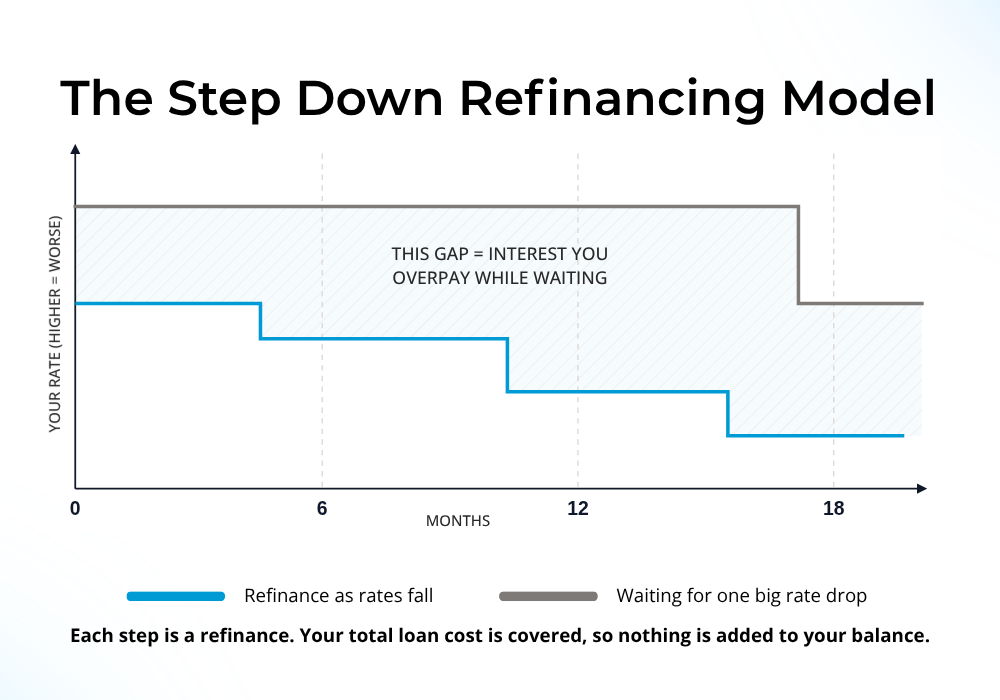
Step Down Refinancing is the strategy behind that plan. Rather than waiting years for a single large rate drop, you lower your rate in smaller increments as the market falls. And because Seattle's Mortgage Broker covers your total loan cost each time, nothing is added to your balance, and there’s no upfront fee to recover before the savings begin.
A rate on a screen is a one-time number, but a broker who understands your entry, your exit, and your long-term strategy delivers savings across every refinance that follows.
The right broker sets up the deal, but you have just as much control over the final rate. Lenders don't offer everyone the same number. They price each borrower based on risk, so the less risk you appear to carry and the better prepared you are, the lower the rate they offer.
Three habits work in your favor.
First, act the day a rate works. Lenders set current mortgage rates off the market each morning, and the market shifts by the hour, so the number you see at 9 a.m. can be gone by noon.
When a rate hits the level that makes sense for you, get your rate lock in place. Don't wait a day to think it over. This is far easier when the refinance costs you nothing, because with no fees to earn back, there's no break-even to calculate.
Second, over-prepare your paperwork. Lenders charge more when they're unsure they'll be repaid, so the cleaner your proof of income, assets, and savings, the less doubt they price into your credit profile, and the lower your rate.
Gather your pay stubs, bank statements, and tax returns before anyone asks. Hunting for a missing document mid-process slows everything down, and delays are how a locked rate expires before you sign.
Third, refinance before you're forced to. A lender gives its best terms to the borrower who isn't desperate, which is the point of Step Down Refinancing. You don't wait for a crisis. You capture each rate drop early, on your own schedule, again and again.
The interest rate only covers the cost of borrowing, and the fees underneath are what grow your loan and cost you for years. So the number that decides everything was never the rate in the ad that popped up on your lunch break but your total loan cost, which is the full price of the refinance from start to finish.
Once you drive that number to zero everything changes, because a lower rate no longer comes chained to a bigger balance, and refinancing stops being a once-a-decade event you save up for. It becomes something you do the moment a better mortgage rate gives you room, which is exactly what Step Down Refinancing is built for. And because it applies to your primary residence, it fits the home you already live in rather than some new purchase.
Plus, with Seattle's Mortgage Broker covering your total loan cost, every rate drop reaches you without adding a dollar to what you owe. If you’re ready to explore your refinancing options, book a Step Down Refinance review with Seattle's Mortgage Broker and find out what your mortgage rate looks like once the fees are gone.
Joe Tafolla is the founder and lead mortgage broker at Seattle’s Mortgage Broker, a full-service mortgage consulting firm dedicated to helping homebuyers secure financing with competitive rates, faster closings, and personalized service.
With more than two decades in the mortgage industry, Joe has helped hundreds of families achieve homeownership.